
Allergy Season Survival Guide: The #1 Furnace Filter Upgrade You Need
If allergies are making your life miserable, your HVAC system could be part of the problem. Indoor air is often more polluted than outdoor air, and standard furnace filters aren’t designed to protect your health. ElectroDust reusable filters offer a smarter option. These electrostatic filters trap allergens like pollen, pet dander, and dust mites while being washable and reusable for up to 10 years. With a MERV 7 rating, they balance effective filtration and smooth airflow, making them a cost-effective and eco-friendly solution for allergy relief.
Key Takeaways:
- Indoor air can be 5x more polluted than outdoor air.
- ElectroDust filters trap allergens using static electricity.
- Reusable for up to 10 years, saving money and reducing waste.
- MERV 7 rating ensures effective filtration without overworking your HVAC system.
- Clean every 30–45 days for best performance.
Switching to ElectroDust filters helps improve air quality, reduces allergens, and saves on disposable filter costs - all while being easy to maintain. Let’s dive into how these filters work and why they’re a game-changer for your home.
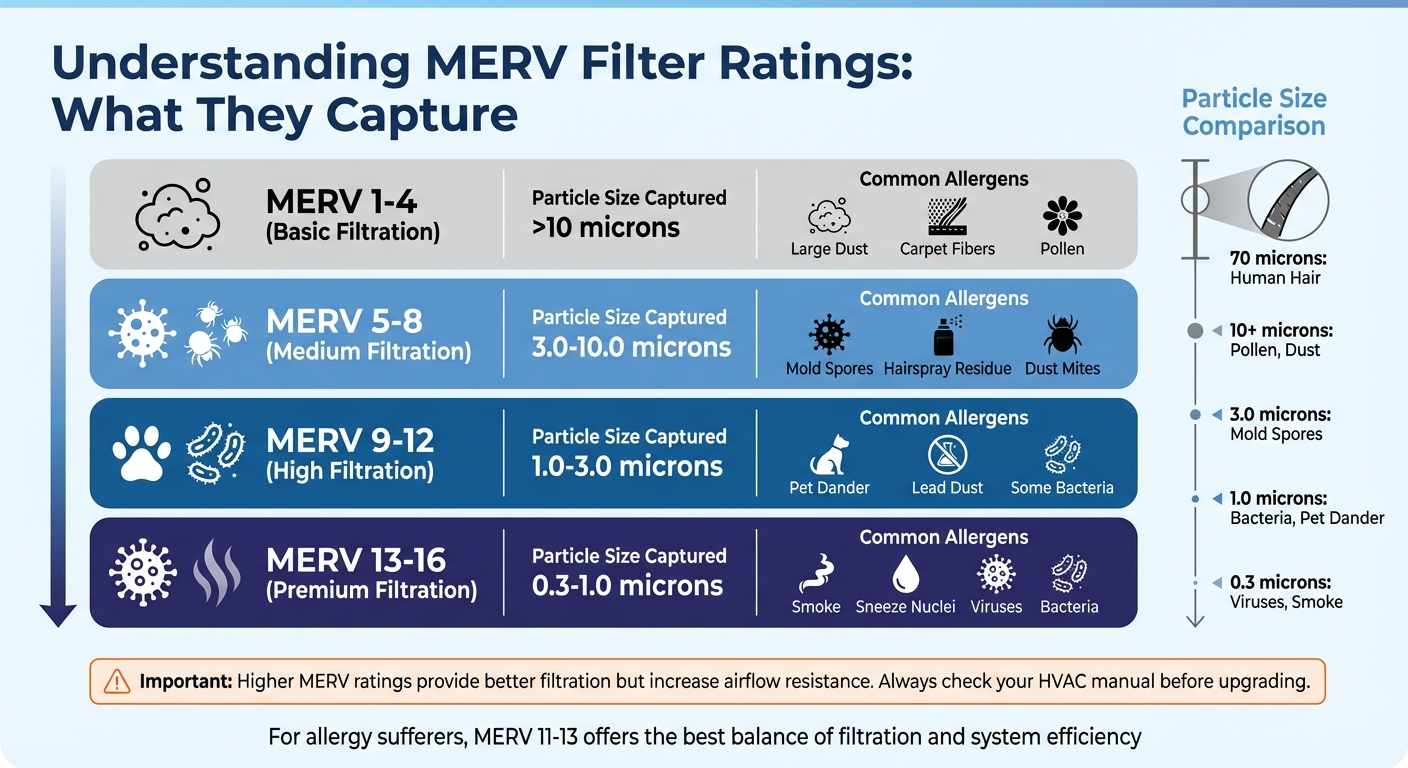
MERV Filter Ratings and Allergen Capture Comparison Chart
Common Indoor Allergens That Affect Your Health
Your home can be a hotspot for allergens, especially during allergy season. The usual suspects include pollen brought in from outside, pet dander (tiny skin flakes), dust mites, mold spores, cockroach debris, and even textile fibers. These allergens are notorious for triggering sneezing, watery eyes, stuffy noses, and restless nights.
What makes many of these indoor allergens so problematic is their ability to linger. Pet dander, for example, is "sticky" and clings to surfaces, while dust mites often settle into bedding and upholstery. Once disturbed, these particles go airborne and become even harder to avoid. According to the EPA, indoor air pollution ranks among the top five environmental health risks, with 80% of Americans exposed to dust mites and 60% regularly encountering pet dander. This highlights the need for furnace filters that don’t just trap allergens but also manage them effectively.
How Furnace Filters Capture Airborne Particles
Your HVAC system plays a key role in managing indoor air quality. It pulls air from your home through intake vents, passes it through a filter, and then redistributes it through the ducts. The filter works like a sieve, capturing particles while allowing clean air to flow back into your living space.
There are two main types of filters: mechanical and electrostatic. Mechanical filters physically trap particles, while electrostatic ones use static charges to hold onto them. High-efficiency filters take it a step further, catching even the tiniest allergens like pollen, pet dander, mold spores, dust mites, and potentially harmful bacteria or viruses. This can lead to a measurable 70% improvement in indoor air quality.
What MERV Ratings Mean for Your Filter
The MERV (Minimum Efficiency Reporting Value) rating is the standard measure of a filter's ability to trap airborne particles. The scale ranges from 1 to 16 for residential filters, with higher numbers indicating finer filtration. For those dealing with allergies, MERV ratings between 11 and 13 strike the perfect balance.
| MERV Rating | Particle Size Captured | Common Allergens Captured |
|---|---|---|
| MERV 1–4 | >10 microns | Large dust, carpet fibers, pollen |
| MERV 5–8 | 3.0–10.0 microns | Mold spores, hairspray residue, dust mites |
| MERV 9–12 | 1.0–3.0 microns | Pet dander, lead dust, some bacteria |
| MERV 13–16 | 0.3–1.0 microns | Smoke, sneeze nuclei, viruses, bacteria |
While higher MERV ratings offer better filtration, they also come with increased airflow resistance. If your HVAC system isn’t designed to handle a MERV 13 filter, it could lead to reduced efficiency, higher energy bills, or even damage to the blower motor. To avoid these issues, always check your HVAC manual before upgrading to a higher-rated filter.
Understanding how filters work and their efficiency is key to choosing the right one for your home. This knowledge ties directly into why ElectroDust reusable filters stand out as an excellent option for allergy relief.
Why ElectroDust Reusable Filters Work Best for Allergies

How Electrostatic Filters Capture Allergens
When it comes to tackling indoor allergens, electrostatic filters take filtration to the next level. Unlike standard filters that simply block particles, these filters generate a static charge that actively attracts allergens like dust, pollen, and pet dander. This mechanism allows them to trap even tiny particles measuring between 2 and 12.5 microns as air flows through their woven screens.
Research backs this up. Studies reveal that electrostatic air cleaners remove house dust mite particles 11.4 times more effectively than natural settling does in just 15 minutes. Additionally, one study found that using an electrostatic filter reduced Der f 1 - a major dust mite allergen - by an impressive 60.3%.
Another key feature of these filters is agglomeration. This process causes smaller particles to clump together inside the filter, increasing their mass and ensuring they remain trapped instead of circulating back into your home. These advanced mechanics highlight what sets ElectroDust filters apart from the rest.
What Makes ElectroDust Filters Different
ElectroDust filters bring together the power of electrostatic technology with a washable, reusable design that’s built to last up to 10 years. Made in Canada, these filters feature durable aluminum frames and polyester media that can handle repeated washing without breaking down.
With a MERV 7 rating, ElectroDust filters effectively capture allergens like dust mites, mold spores, and pollen, all while maintaining smooth airflow in residential HVAC systems. They’re also available in custom sizes to fit non-standard dimensions and come with a lifetime warranty. Customers have taken notice, giving these filters an average rating of 4.6 out of 5 stars based on 84 reviews. Many praise the noticeable improvement in air quality and the sturdy construction.
"By choosing ElectroDust filters, customers can trust that they are making a conscientious choice for the environment without compromising on quality or efficiency." - ElectroDust
The environmental benefits are worth noting too. ElectroDust has already kept over 10,000 filters out of landfills. Each reusable filter replaces dozens of disposable ones, helping to reduce the staggering 508 million filters Americans discard annually.
How to Install Your ElectroDust Filter
Step 1: Verify Your System and Measure Your Filter Size
Before ordering your ElectroDust filter, it’s important to double-check your filter size and confirm your HVAC system’s compatibility. Start by locating your current filter, usually found between the return air duct and the furnace. The dimensions of the filter are often printed on the frame (e.g., "16x25x1"). If the size isn’t visible, grab a tape measure and measure the slot dimensions, rounding up to the nearest inch.
Next, refer to your HVAC system manual to determine the maximum MERV rating it supports. ElectroDust filters have a MERV 7 rating, which works well for most residential systems. However, if your system isn’t built for higher-efficiency filters, the increased airflow resistance could strain the blower motor or even lead to problems like a frozen evaporator coil. Most residential systems use 1-inch thick filters, but some high-efficiency models may require thicker filters, typically between 2 and 5 inches.
Once you’ve confirmed the correct size and compatibility, you’re ready to install your ElectroDust filter.
Step 2: Install the Filter
When your ElectroDust filter arrives, start by turning off your HVAC system. Open the access panel, remove the old filter, and take note of the airflow direction marked on it. This is key for installing the new filter correctly.
Slide the new filter into the slot with the arrow pointing toward the blower. It should fit snugly without bending or forcing it into place. Proper installation ensures unfiltered air doesn’t bypass the filter.
"A properly fitted filter sits snug in the compartment without bending or forcing. You should see minimal gaps around the edges - small spaces are normal and won't hurt performance." - Filterbuy
Once the filter is in place, close the access panel securely and turn the HVAC system back on. Your ElectroDust filter is now set up and ready to trap allergens and improve air quality.
The next step is to ensure you maintain the filter regularly for optimal performance.
Step 3: Set Up a Cleaning Routine
To keep your ElectroDust filter working at its best, clean it every 30–45 days during heavy-use months and every 60 days during lighter-use periods. It’s a good idea to set reminders on your phone or mark your calendar to stay on schedule. If you have pets or live in a dusty environment, inspect the filter monthly and clean it as soon as it looks gray or clogged.
Always keep a spare ElectroDust filter on hand to maintain airflow while cleaning the current one. This way, your system runs smoothly without interruptions.
How to Clean and Maintain Your ElectroDust Filter
Cleaning and Drying Your Filter Properly
Start by turning off your HVAC system to avoid circulating unfiltered air. Carefully remove the filter to keep dust from spreading. Use a vacuum with a brush or crevice attachment to clear away loose dust on the surface - this step ensures dust doesn't clump when you rinse it.
Next, rinse the filter thoroughly with lukewarm water using a hose or spray nozzle. Be sure to spray both sides to dislodge trapped particles. If there's heavy buildup, apply a small amount of mild detergent and rinse until the water runs clear. Avoid using harsh chemicals, bleach, or industrial cleaners, as these can damage the electrostatic fibers.
"A washable furnace filter can be cleaned using plain water or a mild detergent on either side of the filter."
– Filter King
After rinsing, shake off any excess water and leave the filter to air dry completely, which usually takes about 24 hours. This step is crucial to prevent mold and microbial growth. To make the process easier, consider keeping a spare filter on hand.
Once your filter is clean and dry, it’s important to recognize the signs that it’s time for the next cleaning to keep your system running smoothly.
When Your Filter Needs Cleaning
Your ElectroDust filter will need cleaning when you notice visible dust buildup or a fuzzy layer forming on its surface. Other telltale signs include increased sneezing or allergy symptoms, a sudden rise in energy bills, or more dust settling on furniture. For a quick test, hold the filter up to a light source - if light doesn’t pass through, it’s clogged and needs immediate attention.
During peak pollen seasons, like spring and fall, clean your filter every 30 days to ensure it captures allergens effectively, even if it looks relatively clean.
Adjust your cleaning routine to suit your home’s specific needs for the best results.
Adjusting Maintenance Based on Your Home
How often you clean your filter depends on your living conditions. If you have pets, aim for a cleaning every 3–4 weeks to manage the extra pet dander and fur. In dusty regions, such as parts of Arizona or Texas, inspect your filter monthly and clean it every 1–3 months as needed.
Here’s a quick reference guide to help you customize your cleaning schedule:
| Factor | Cleaning Frequency | Reason |
|---|---|---|
| Household | Every 4–6 weeks | Maintains airflow and system efficiency |
| Pets (Dogs/Cats) | Every 3–4 weeks | Reduces pet hair and dander buildup |
| Dusty Environments | Every 1–3 months | Handles high levels of dust in dry climates |
| Allergy Sufferers | Every 30 days | Keeps allergens under control during peaks |
If you live in an older home, you might need to clean your filter more often, as gaps in doors, windows, and insulation can let in more dust and pollutants. Tailoring your maintenance routine ensures your filter performs at its best.
Additional Ways to Reduce Allergens at Home
Use Your HVAC Fan Settings to Improve Air Circulation
For your ElectroDust filter to work efficiently, consistent airflow is key. Many HVAC systems operate less than 25% of the time during typical heating and cooling seasons, meaning the filter is only active during those periods. During high-pollen seasons, try setting your thermostat fan to "On" or "Circulate." This keeps air moving continuously through the filter, ensuring allergens are consistently trapped. While this may slightly bump up your electricity bill, the payoff in cleaner air is well worth it - especially since most people spend about 90% of their day indoors.
Reduce Allergen Sources Inside Your Home
Even the most advanced filter won't help much if allergens keep sneaking in. To minimize indoor allergens, keep windows closed on high-pollen days and place mats at every entryway to catch outdoor debris. Studies show that 80% of Americans encounter dust mites, and 60% are exposed to pet dander. To combat this, aim to maintain indoor humidity levels between 35% and 50%, as this discourages both dust mites and mold growth.
Other helpful steps include vacuuming once or twice a week with a HEPA vacuum, which captures 99.97% of particles as small as 0.3 microns. Wash your bedding weekly in water heated to at least 130°F, and use a damp microfiber cloth when dusting to trap particles instead of spreading them around.
"There are definitely some steps you can take around your house to make allergy season more bearable."
– Dr. Flora Sinha, Primary Care Doctor, Cedars-Sinai
These small but effective habits, combined with a high-performing filter, can make a noticeable difference in reducing allergens at home.
Combining Filters with Other Allergy Management Steps
Your ElectroDust filter works best as part of a larger strategy to tackle allergens. Combining filtration with other measures, like reducing allergen sources, can significantly improve indoor air quality. The U.S. Environmental Protection Agency (EPA) emphasizes that air filtration should complement - not replace - source control and ventilation. As the EPA explains:
"The most effective ways to improve your indoor air are to reduce or remove the sources of pollutants and to ventilate with clean outdoor air. In addition, research shows that filtration can be an effective supplement to source control and ventilation."
– U.S. Environmental Protection Agency
To further reduce allergens, consider keeping pets out of bedrooms, grooming them outside to limit dander, and washing their bedding frequently. Regularly cleaning bathroom tiles can help prevent mold buildup, and limiting the number of indoor plants may reduce exposure to mold spores found in soil.
Conclusion
Switching to an ElectroDust reusable filter can make a big difference during allergy season. Its electrostatic fibers are designed to trap up to 95% of allergens, including pollen and mold spores, and it offers reliable performance for years with just simple monthly upkeep. This combination of efficiency and durability not only helps your health but also translates into savings and eco-friendly benefits.
While washable filters may have a higher initial cost, they eliminate the need for frequent replacements, which can add up to $68–$120 per year. Over time, this means more money in your pocket. Plus, by cutting down on waste, reusable filters help reduce household trash and shrink your carbon footprint.
FAQs
How effective is the ElectroDust MERV 7 filter at capturing allergens compared to higher-rated filters?
The ElectroDust MERV 7 filter works well for catching larger particles like dust and lint. However, it struggles to trap finer allergens such as pollen, pet dander, and dust mites. If you're looking for better relief from allergies, consider filters with a MERV rating between 11 and 13. These filters are designed to capture smaller particles that are common allergy triggers. Switching to a higher-rated filter can make a noticeable difference in your indoor air quality, particularly during allergy season.
What should I consider before using a reusable filter like ElectroDust in my HVAC system?
Reusable filters, such as ElectroDust, come with the perks of being environmentally friendly and saving money over time. However, there are a few things to consider before making the switch. One key factor is maintenance. These filters need to be cleaned regularly - usually once a month - to ensure proper airflow and performance. After washing, they must dry completely, which typically takes around 20–30 minutes, before being reinstalled. For those juggling a packed schedule, this upkeep might feel like a hassle.
Another point to keep in mind is their filtration capability. While reusable filters do a good job of capturing larger particles like dust and pollen, they may fall short when it comes to trapping finer allergens, smoke, or bacteria compared to high-MERV disposable or HEPA filters. This could pose a challenge for individuals with severe allergies or asthma. Additionally, reusable filters tend to cost more upfront, and improper cleaning or drying can lead to issues like mold growth or unpleasant odors. It’s worth weighing these factors carefully to determine if a reusable filter fits your lifestyle and specific needs.
How often should I clean my ElectroDust filter if I have several pets at home?
If you share your home with multiple pets, aim to clean your ElectroDust filter every 4 to 6 weeks. This routine helps keep your air fresh by removing pet hair, dander, and other allergens that tend to build up faster in pet-friendly households.
By sticking to this schedule, you’ll ensure your filter works effectively, keeping your indoor air cleaner - not just during allergy season, but all year round.