

How to Calculate Savings with Reusable Filters
A reusable filter can cost more on day one, but it can cost less over 5 to 10 years. If you know four numbers - filter price, replacement schedule, reusable filter price, and cleaning cost - you can figure out your yearly cost, total savings, and payback time.
Here’s the short version:
- I compare annual disposable filter cost to annual reusable filter cost
- I check the 5-year and 10-year totals
- I include cleaning supplies and, if I want, my time
- I use payback period to see when the upfront cost is covered
A simple example from the article shows the gap clearly:
- Disposable filters: $60 per year
- Reusable filter: $130 upfront + about $2 per year in cleaning supplies
- 5-year cost: $300 vs. $140
- 10-year cost: $600 vs. $150
- Payback: about 2.2 years
That means a reusable filter can save about $160 in 5 years and about $450 in 10 years in that sample case.
What I need to gather first:
- Price per disposable filter
- How often I replace it, such as every 1, 2, or 3 months
- Reusable filter purchase price and lifespan, such as 5 or 10 years
- Cleaning cost per wash, often about $0.50
- Optional labor cost, such as 15 minutes at $20/hour = $5 per cleaning
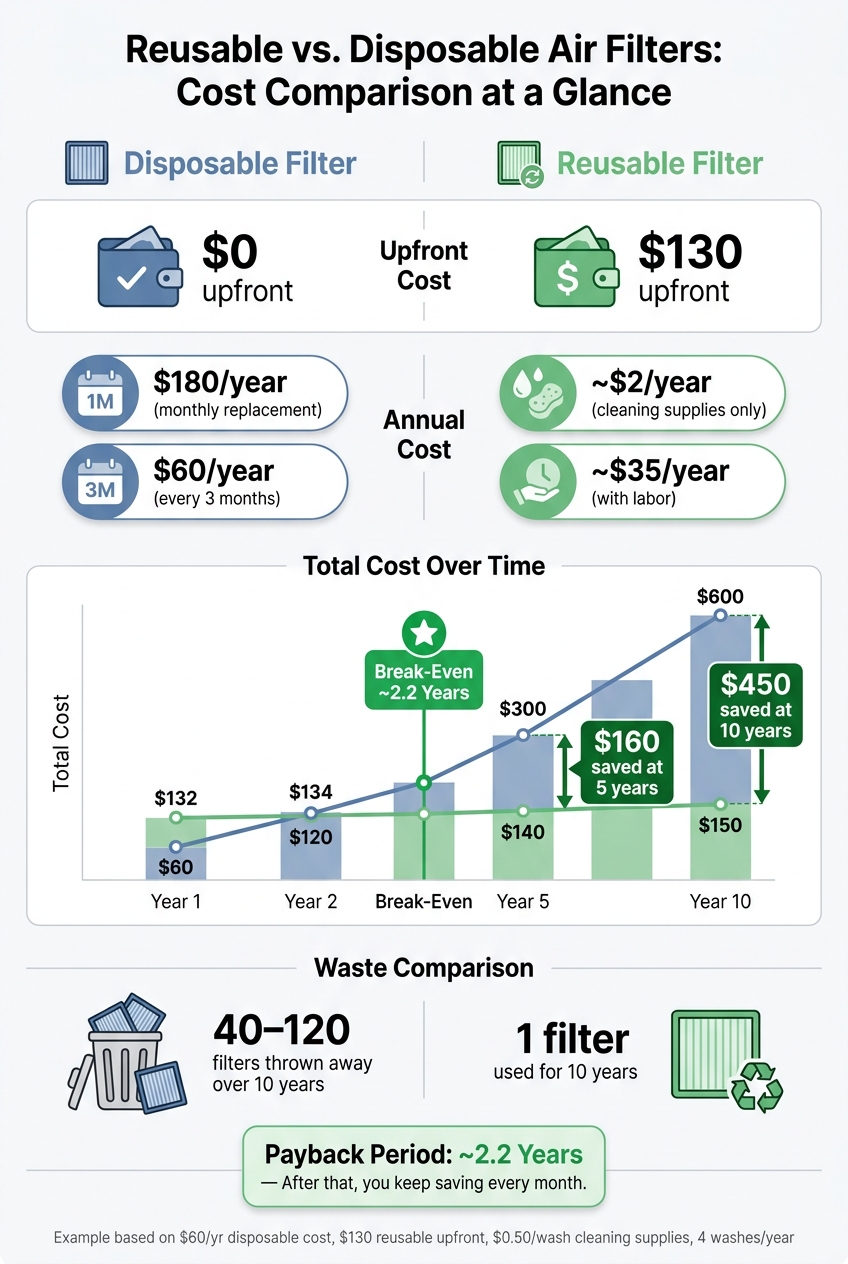
Reusable vs Disposable Air Filters: 10-Year Cost Comparison
sbb-itb-adeab55
Quick Comparison
| Cost Check | Disposable Filter | Reusable Filter |
|---|---|---|
| Day-one cost | Low | High |
| Yearly cost | Repeats all year | Mostly cleaning cost after purchase |
| 5-year total | Often higher | Often lower |
| 10-year total | Much higher in many cases | Lower if cleaned on schedule |
| Payback | Not applicable | Often around 2–3 years in common cases |
| Waste | 4–12+ filters per year | 1 filter used for years |
Bottom line: if I replace disposable filters often, a reusable filter usually starts to make more financial sense over time. The main job is simple: run the numbers with my own prices and cleaning routine.
Step 1: Calculate What You Currently Spend on Disposable Filters
Find Your Price Per Filter and Replacements Per Year
Start with two numbers: your cost per filter and how often you replace it.
If you buy multipacks, just divide the total pack price by the number of filters to get your per-filter cost.
Homes with pets, allergies, or HVAC systems that run a lot often need filter changes more often. So if your house fits that description, you’ll likely fall on the shorter end of the replacement range.
Annual Disposable Cost Formula
Once you have your filter price and how many you use each year, the math is simple:
Annual Disposable Cost = Price per Filter × Filters per Year
Use that formula as your starting point, then compare your numbers to the schedule below:
| Replacement Interval | Filters Per Year | At $5/filter | At $15/filter | At $30/filter |
|---|---|---|---|---|
| Monthly | 12 | $60 | $180 | $360 |
| Every 2 months | 6 | $30 | $90 | $180 |
| Every 3 months | 4 | $20 | $60 | $120 |
| Every 6 months | 2 | $10 | $30 | $60 |
If you replace more than one filter each cycle, multiply your annual total by that number. Keep that final yearly cost handy for the next step.
Step 2: Estimate the Cost of a Reusable Filter Over Time
Upfront Price, Lifespan, and Cleaning Costs
Next, turn the reusable filter into a yearly cost.
A reusable filter usually costs about $130 upfront. The good news is that, with proper care, it can last for years.
You’ll need to wash it every 1–3 months with water and mild detergent. If you have pets or allergies, plan on washing it about every 30 days. Cleaning supplies cost about $0.50 per wash.
You can also count your time if you want a full side-by-side cost check. At 15 minutes per wash and $20/hour, that comes to $5 per wash.
Turn Upfront Cost Into Annual Cost
To compare this fairly with Step 1, convert the filter’s upfront price into a yearly figure. Use the same annual basis from Step 1 so you’re comparing apples to apples :
Annual Reusable Cost = (Purchase Price ÷ Lifespan in Years) + (Cleaning Cost per Wash × Washes per Year)
With a $130 upfront cost and 4 cleanings per year, the 10-year cost works out to about $15/year before labor, or $35/year if you include labor .
Here’s how that yearly cost changes based on how often you clean the filter and whether you count your time:
| Household Type | Cleanings/Year | Cleaning Supplies/Year | With Labor | Total Annual Cost (on $130 filter, 10-yr life) |
|---|---|---|---|---|
| Standard | 4 | $2 | $20 | ~$35 |
| Pets or Allergies | 12 | $6 | $60 | ~$79 |
Use that annual reusable cost in Step 3 to calculate total savings.
Step 3: Compare Total Costs and Calculate Your Savings
Once you have the annual totals from Steps 1 and 2, put them on the same timeline. That’s when the price gap starts to show.
Instead of looking at one year at a time, compare the full cost over 5 years or 10 years.
5-Year and 10-Year Cost Differences
Use these formulas:
- Total Disposable Cost = Annual Disposable Cost × Number of Years
- Total Reusable Cost = Upfront Filter Price + (Annual Cleaning Cost × Number of Years)
- Savings Over X Years = Total Disposable Cost − Total Reusable Cost
Plug in your own numbers and you’ll see how much the gap grows over time.
Here’s a simple example. If disposable filters cost $60/year, the total comes to $300 over 5 years and $600 over 10 years. A reusable ElectroDust filter with a $130 upfront price and $2/year for cleaning supplies after 4 washes, with no labor included, comes to $140 over 5 years and $150 over 10 years. That works out to about $160 in savings over 5 years and $450 over 10 years.
How to Find the Payback Period
The payback period shows how long it takes for the money you’re no longer spending on disposable filters to cover the upfront filter cost.
Payback Period = Upfront Filter Price ÷ Annual Savings
Annual Savings = Annual Disposable Cost − Annual Cleaning Cost.
Using $60/year for disposable filters and $2/year for cleaning supplies, a $130 reusable filter pays for itself in about 2.2 years. If you want to factor in labor, just add that amount to the annual cleaning cost before you run the math.
The table below puts those numbers side by side.
Cost Comparison Table
This example uses $60/year for disposable filters and the reusable filter setup from Step 2: $130 upfront, 4 washes per year, cleaning supplies only, and no labor cost.
| Filter Type | Upfront Price | Annual Cost | 5-Year Total | 10-Year Total | Payback Period |
|---|---|---|---|---|---|
| Disposable (Every 3 Months) | $0 | $60 | $300 | $600 | N/A |
| Disposable (Monthly) | $0 | $180 | $900 | $1,800 | N/A |
| Reusable (ElectroDust) | $130 | $2* | $140 | $150 | ~2.2 years |
*Assumes basic cleaning supplies only, no labor cost.
Use this base case to test time, waste, and maintenance tradeoffs in the next step. Next, refine the estimate for labor, waste, and HVAC impact.
Step 4: Refine Your Estimate and Review Key Takeaways
Time Savings, Waste Reduction, and HVAC Protection
Start with your total cost numbers. Once you've worked out the payback period, add the non-price factors that shape the day-to-day choice.
Maintenance time matters. Disposable filters mean buying replacements again and again. Reusable filters trade that for a wash cycle every 1–3 months. HVAC efficiency matters too. When a reusable filter stays clean, it helps maintain optimal airflow, which can lower system strain and cut energy use.
So the dollar math only tells part of the story.
Waste is the other big piece. Over 10 years, one reusable filter can keep 40–120 disposable filters out of the trash. That doesn't show up in your cost total, but it does make the switch look stronger.
Build Your Own Savings Table
Use this template with your own numbers. Round replacements and cleanings up to whole numbers so you don't undercount what you'll spend in real life.
| Input Variable | Disposable Filter | Reusable Filter |
|---|---|---|
| Unit Price / Upfront Cost | $___ | $___ |
| Replacement / Cleaning Interval | Every __ months | Every __ months |
| Cost per Replacement / Cost per Wash | $___ | $___ |
| Total Annual Cost | $___ | $___ |
| 5-Year Total Cost | $___ | $___ |
| 10-Year Total Cost | $___ | $___ |
Reusable filters need about 12 hours to air-dry. If your household uses two filters, include both in the upfront cost.
Conclusion: The Key Numbers to Compare
Four numbers should drive the choice:
- your current annual disposable cost
- your reusable filter's annual cost
- your total savings over 5 and 10 years
- your payback period
When you compare the two options, pay most attention to the 5-year and 10-year totals, not just the sticker price.
A reusable filter, if you keep up with maintenance, can replace years of repeat purchases and keep dozens of used filters out of the trash. Once your own numbers are filled in, the comparison gets pretty simple.
FAQs
How do I know if a reusable filter is worth it for my home?
Compare the upfront price with the money you can save over time, and be honest about how much upkeep you’re willing to do. Reusable ElectroDust filters often pay for themselves in 10 months to 2 years. And they can last up to 10 years, which helps cut replacement costs and reduce waste.
There’s a catch: they need regular cleaning. Plan to wash them with mild soap and water every 1 to 3 months. You’ll also want to check that the filter’s MERV rating matches your air quality needs and doesn’t restrict your HVAC system’s airflow.
Should I count cleaning time in the savings calculation?
That depends on how deep you want the comparison to go.
You don’t need to factor in cleaning time. But if you want a more complete money breakdown, you can put a dollar amount on maintenance time too.
For example, if washing your ElectroDust filter takes 15 minutes and you value your time at $20 per hour, that adds $5 per cleaning.
For most people, though, maintenance is pretty small and is usually offset by the money saved over time.
What numbers do I need to compare filter costs?
Gather these numbers before you compare costs:
- Disposable filter price per unit and how often you usually replace it
- Reusable filter upfront price
- If you want a more precise comparison: cleaning supply costs, maintenance time, cleaning frequency, and how many years you want to compare
For disposable filters, use the actual price you pay per filter. That means factoring in any bulk discounts or subscription savings.