

How Ventilation Affects Home Humidity
Ventilation can make your home drier or more humid - it depends on your weather, your home, and how you move air. In most North American homes, I’d aim for 30% to 50% indoor humidity, and I’d try to keep it under 60% to help cut down on mold, dust mites, and window condensation.
Here’s the short version:
- Too little ventilation traps moisture from showers, cooking, laundry, and people breathing.
- Too much ventilation can dry out indoor air in winter, especially in cold parts of the U.S.
- Outdoor air matters: dry outdoor air can lower indoor humidity, while hot, muggy outdoor air can make indoor humidity go up.
- Ventilation and filtration are not the same thing: filters catch dust and pollen, but they do not change humidity.
- Source control works first: run bathroom fans during showers and for 20–30 minutes after, and use a vented range hood when cooking.
- Whole-house systems matter: HRVs often fit cold climates, while ERVs often fit hot-humid or mixed climates better.
- A hygrometer helps: if you can measure RH, you can spot problems before they turn into mold, peeling paint, dry skin, or static.
If I had to sum it up in one line, it would be this: good humidity control comes from matching ventilation to your climate and your moisture load - not just moving more air.
| Situation | What usually happens |
|---|---|
| Under-ventilated home | RH often goes above 60%; more condensation, musty smells, mold risk |
| Over-ventilated home | RH can drop below 30%; dry skin, irritated sinuses, static |
| Balanced setup | RH usually stays near 30%–50%; fewer comfort and moisture problems |
So when I look at home humidity, I don’t just ask, “Do you have ventilation?” I ask, “Is the amount and type of ventilation right for your house and your weather?”
Ventilating Airtight Homes: ERV vs HRV Explained
sbb-itb-adeab55
Humidity Problems Caused by Poor Ventilation
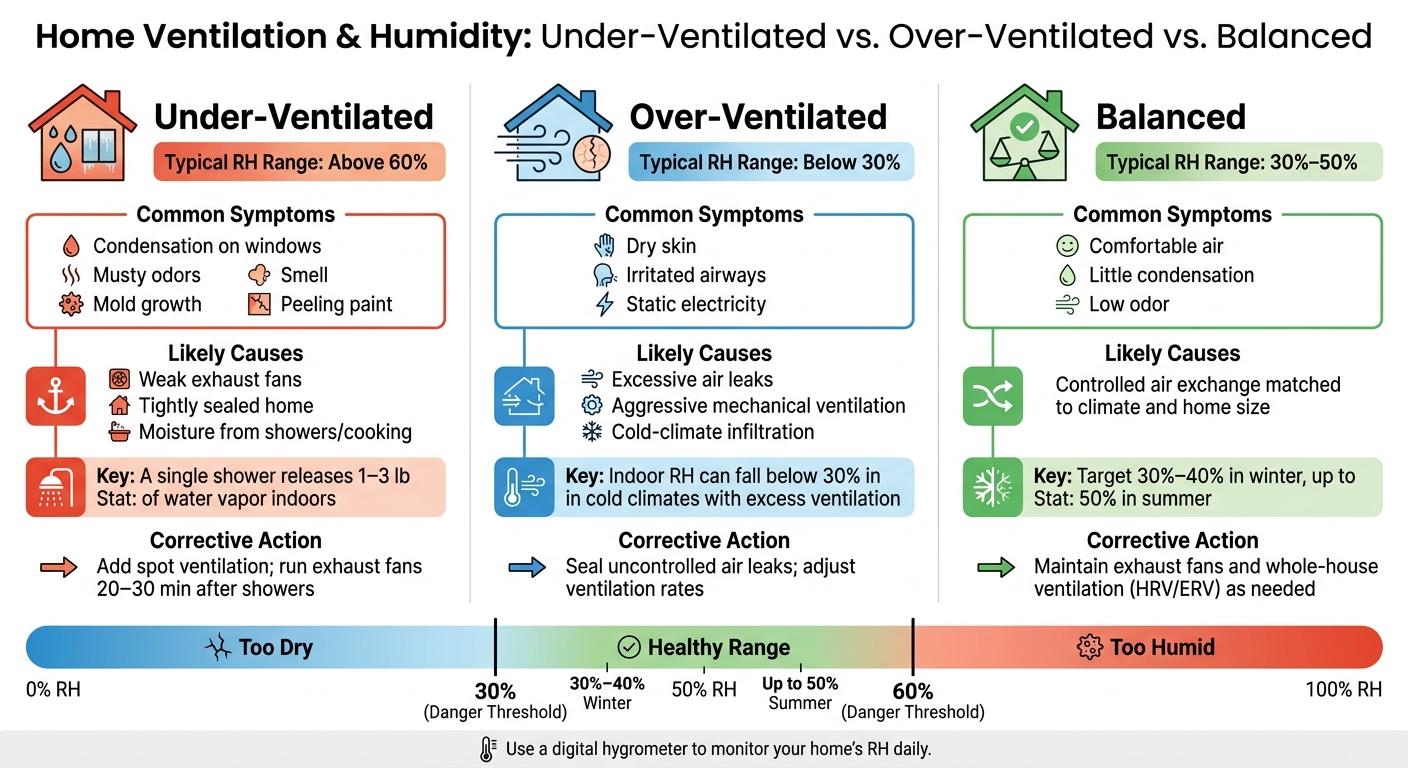
Home Ventilation & Humidity: Under-Ventilated vs. Over-Ventilated vs. Balanced
Ventilation problems usually come from too little air exchange or too much. Both throw off indoor moisture balance, just in different ways.
The main issue isn't fresh air by itself. It's whether the amount of air moving in and out fits the home's moisture load. Climate matters. So does how tightly the house is built. And daily habits matter too, from showers to cooking to laundry.
How Under-Ventilation Traps Too Much Moisture
When ventilation is too weak, indoor moisture piles up faster than it can leave.
Showers, cooking, laundry, and even breathing all add water vapor to the air. A single shower can release about 1 to 3 lb of water vapor indoors. If the exhaust fan is weak, missing, or shut off too soon, that moisture hangs around. Over the course of a day, RH can climb well above 60%.
Basements, crawlspaces, and tightly sealed homes are common trouble spots. Air sealing helps with energy use, but it also cuts down on the cracks and gaps that once let moisture escape.
The warning signs tend to show up fast:
- Condensation on windows
- Musty smells in bathrooms or closets
- Mold on grout or around vents
- Paint that peels or bubbles
When RH stays above 60%, mold and dust mites have the kind of damp setting they like. At that point, building materials can also start soaking up extra moisture.
How Over-Ventilation Dries Out Indoor Air
The other side of the problem is easier to miss, but it matters just as much.
In colder parts of the U.S., winter air outside contains very little moisture. When that air gets pulled into a house through leaks in the building envelope or from a ventilation system running too hard, it warms up indoors and its relative humidity drops fast. Indoor RH can fall below 30% in those conditions.
That leaves the air feeling dry, harsh, and uncomfortable.
Comparison Table: Under-Ventilated vs. Over-Ventilated vs. Balanced Homes
| Ventilation Condition | Typical RH Range | Common Symptoms | Likely Causes | Main Corrective Action |
|---|---|---|---|---|
| Under-Ventilated | High (above 60%) | Condensation, musty odors, mold, peeling paint | Weak exhaust fans, sealed home, moisture from showers and cooking | Add spot ventilation; run exhaust fans long enough after showers and cooking |
| Over-Ventilated | Low (below 30%) | Dry skin, irritated airways, static electricity | Excessive air leaks, aggressive mechanical ventilation, cold-climate infiltration | Seal uncontrolled air leaks; adjust ventilation rates |
| Balanced | Healthy (30–50%) | Comfortable air, little condensation, low odor | Controlled air exchange matched to climate and home size | Maintain exhaust fans and whole-house ventilation as needed |
In actual homes, the outcome depends on outdoor weather, how much air leaks in and out, and what kind of ventilation system is doing the work.
How Ventilation Changes Humidity in Real Conditions
Indoor humidity comes down to three things: how much moisture your home makes, how much moisture is in the air outside, and how often indoor air gets swapped with outdoor air.
And homes make more moisture than many people think. A family of four can put 7–12 liters (1.8–3.2 gallons) of water vapor into the air each day from showering, cooking, and breathing. If you dry laundry indoors, that total can climb past 23 liters (6 gallons).
So the practical question is simple: Does outside air help dry the house out, or does it bring more moisture in?
When Ventilation Lowers Humidity
Ventilation helps when the outdoor air is cooler and drier than the air inside. That’s usually the case in fall and winter across colder parts of the U.S., where outside air holds very little water vapor. Once that air comes inside and warms up, its relative humidity drops.
This is why basic exhaust steps can work so well in cold weather. Run bathroom fans during showers and for about 20 minutes after. That can cut bathroom humidity by up to 40% and reduce condensation buildup by as much as 50%. A ducted range hood does the same job in the kitchen by pulling steam out before it drifts through the house.
When Ventilation Raises Humidity
In hot, humid parts of the country, including the Gulf Coast and the Southeast, the outside air often holds more moisture than the air indoors. Bring that air in, and your AC or dehumidifier has more water to remove.
That’s not a small effect. Simulations in Houston found that standard ventilation rates increased indoor RH by about 5–10 percentage points. In those climates, exhaust-only systems can be a problem because they pull replacement air through cracks and leaks, and that incoming air may be warm and damp. Instead of helping, the system can add to the cooling load.
That’s why how you ventilate matters just as much as how much you ventilate.
Comparison Table: Open Windows, Exhaust Fans, HRVs, and ERVs
| Ventilation Method | Winter Effect on Humidity | Summer Effect on Humidity | Best Use Case | Energy Tradeoff |
|---|---|---|---|---|
| Open windows | Lowers when outdoor air is dry | Raises in humid climates; lowers in dry climates | Quick air refresh on mild, low-humidity days | No energy recovery; increases heating/cooling load |
| Exhaust fans | Lowers by removing moist air at the source | Lowers locally; may pull in humid replacement air | Bathrooms and kitchens during and after moisture events | Low energy use; no heat recovery |
| Heat-recovery ventilator (HRV) | Lowers by bringing in dry outdoor air while recovering heat | May raise in humid weather | Cold, heating-dominated climates | Higher upfront cost; saves heating energy |
| Energy-recovery ventilator (ERV) | Retains more indoor moisture than an HRV | Limits moisture gain better than an HRV or open windows | Hot-humid and mixed climates | Higher upfront cost; saves both heating and cooling energy |
In plain English, open windows and exhaust fans can work well in the right weather, but mechanical systems like HRVs and ERVs give you more control. The catch is that the right pick depends a lot on climate, not just the fan itself.
How to Keep Indoor Humidity in a Healthy Range
Keep indoor RH between 30% and 50% through the year. In winter, 30% to 40% is a good target. In summer, you can go up to 50%. A digital hygrometer makes this a lot easier. Put one in a bedroom, main living area, or basement so you can see what’s happening day to day.
Once you know if your home is too damp or too dry, you can fix the problem with a few targeted steps.
Use Spot Ventilation Where Moisture Starts
Start where moisture builds up first: the bathroom, kitchen, and laundry area.
In the bathroom, turn on the fan before you start the shower. Let it run during the shower, then keep it on for 20–30 minutes after. In a typical bathroom, a standard 50 CFM fan can bring humidity down from about 80% to 55%–60% during that time. If you take long or extra-hot showers, leave it running for 30–45 minutes instead. The fan should vent outdoors, not into an attic or crawlspace.
In the kitchen, use a range hood that vents outside. Run it on a higher setting while boiling or frying, then leave it on for 10–20 minutes after cooking. In the laundry area, make sure the dryer exhaust also vents outside. The duct should stay short, smooth, and clean so air can move well.
After you deal with moisture at the source, the next step is looking at whole-house ventilation.
Match Whole-House Ventilation to Your Climate and Home Tightness
Whole-house ventilation should fit both your climate and how sealed your home is. Newer homes that are sealed up well often need mechanical ventilation, such as an HRV or ERV, to bring in fresh air and help keep humidity in check. Older or leakier homes can swing both ways: they may get too dry in winter and pull in damp air in summer.
Humidity-sensing controls can help take the guesswork out of it. Bath fans and HRV/ERV systems with built-in RH sensors can ramp up when indoor humidity goes above 50%–55% and ease back when it drops toward 30%. That means the system adjusts on its own instead of relying on you to keep checking it. In hot, humid climates, a dehumidifier can help too, especially in basements if RH stays above 50%–60%.
Pair Better Filtration with Your Humidity-Control Plan
Filtration won’t change RH. But it does help with the stuff humidity can make worse.
A high-efficiency furnace filter can catch particles like dust mites, pollen, pet dander, and mold spores before they move through your home. That matters even more if someone in the house has asthma or allergies.
ElectroDust offers washable, reusable MERV 7 furnace filters that help capture dust, pollen, pet dander, and mold spores. When you pair a filter like this with a ventilation and humidity-control plan that keeps RH in the 30%–50% range, it can help cut down on particles that keep recirculating.
Conclusion: Finding the Right Ventilation Balance
Ventilation doesn't affect humidity the same way in every home. Climate, season, and how tightly a house is sealed all change the result.
A good target is to keep indoor RH between 30% and 50%, and below 60% to help limit mold and dust mites.
The best plan is pretty simple: source control plus balanced ventilation. If you have a forced-air system, one small setting can help a lot. Set the HVAC fan to "Auto" so moisture can drain off the coils instead of evaporating back into your home. It also helps to check and clean your HVAC filter every one to two months so airflow stays steady.
When ventilation, filtration, and moisture control work together, your home usually feels more comfortable and easier to breathe in.
FAQs
How do I know if my home is under-ventilated or over-ventilated?
Your home may be under-ventilated if the air feels stuffy, you notice musty smells, or damp spots start pointing to mold risk. A simple fix is to improve airflow with the right exhaust fans and, if needed, a dehumidifier. It also helps to deal with leaks at the source instead of letting moisture build up.
Over-ventilation is less common, but it can still cause problems. If indoor air is being replaced all the time without keeping humidity in check, moisture issues can get worse, not better. In humid parts of the U.S., running your HVAC fan nonstop can also make it harder for the system to remove humidity, so Auto mode is usually the safer choice.
Should I use an HRV or an ERV for my climate?
Choosing between an HRV and an ERV comes down mostly to your local climate and humidity.
An HRV is often the better fit for colder climates. It helps recover heat while bringing fresh air into the home, which can make winter ventilation less of a drain on your heating system.
An ERV is usually the better choice in humid regions. It transfers both heat and moisture, which helps control indoor humidity more effectively.
Good ventilation matters either way. High-efficiency filters, such as those from ElectroDust, can also help support cleaner indoor air.
Where should I place a hygrometer in my home?
Place your hygrometer in a central spot, away from direct sunlight, heating vents, and drafty windows. Those things can throw off the reading and give you a false sense of what’s happening in the room.
If you want to check moisture in trouble spots, it also helps to monitor areas like basements or bathrooms, where humidity is often higher. Good ventilation can help keep moisture under control, and high-efficiency filters like ElectroDust can help keep the air cleaner.