

Disposable Filters: Hidden Waste Costs
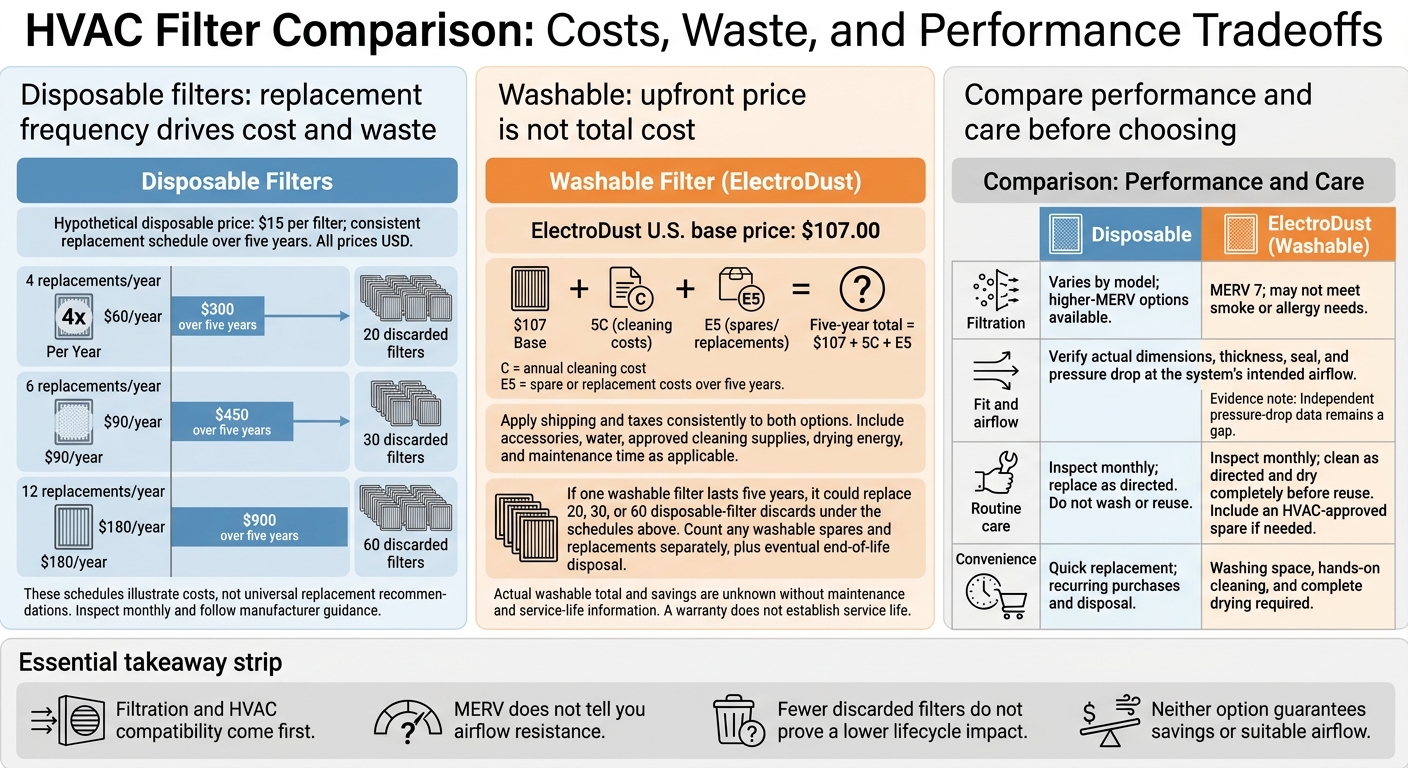
At $15 per filter, disposable furnace filters cost $300–$900 over five years. ElectroDust’s washable filter starts at $107 USD, but cleaning, shipping, spares, and replacement add to that price. Before comparing savings, check the filter’s size, filtration rating, and pressure drop against the HVAC system’s limits.
The tradeoff: disposables offer easy replacement; washable filters reduce discarded units but require washing and complete drying. Fewer discarded filters alone don’t prove a lower total resource footprint.
Quick Comparison
| Factor | Disposable filters | ElectroDust washable filter |
|---|---|---|
| One-year cost | $60–$180 at $15 each, with 4–12 replacements | $107 USD base price, plus cleaning and other costs |
| Five-year cost | $300–$900 under the same assumptions | $107 USD plus five years of cleaning, spares, and any replacement |
| Waste | 20–60 discarded filters over five years | Could replace those disposals if it lasts five years |
| Filtration | Varies by model; higher-MERV options available | MERV 7; may not meet all smoke or allergy needs |
| Airflow and fit | Verify dimensions and pressure drop | Same checks; independent pressure-drop data remains a gap |
| Upkeep | Inspect monthly; replace as directed | Inspect, clean as directed, and dry fully before reuse |
Compare shipping, taxes, accessories, and maintenance time on both sides. Neither option guarantees savings or suitable airflow.
Disposable vs. Washable Furnace Filters: Cost and Waste
Reusable vs Disposable Furnace Filters - Pros, Cons & Best Choice
sbb-itb-adeab55
1. ElectroDust Washable Furnace Filters
ElectroDust uses washable synthetic media in a durable frame, cutting down on routine filter disposal. Check the exact dimensions and thickness before ordering. Deeper racks may need custom sizes or conversion kits, which cost extra. Fit affects both the purchase price and what you’ll spend over time.
Five-Year Ownership Cost
The U.S. base price is $107.00. To estimate your five-year cost, add shipping, accessories, and cleaning expenses. Read the written warranty for coverage limits and required maintenance.
Waste and Resource Use
If the filter lasts five years, it could replace 20 quarterly or 60 monthly disposals. That means fewer discarded filters and less repeated packaging. Manufacturing, shipping, washing, and eventual replacement still contribute to its footprint.
Filtration and Airflow
Ask for pressure-drop data at your system’s airflow, not just the MERV rating. Filtration efficiency alone doesn’t tell you whether a filter will work well with your HVAC system.
Published materials don’t include independent lab results or pressure-drop data. Before using a conversion kit, have an HVAC professional check those specs against your system’s needs. After installation, watch for unusual noise, longer run times, or reduced airflow.
Maintenance Requirements
Inspect the filter monthly. ElectroDust’s guidance describes vacuuming or rinsing, followed by complete drying. Don’t rely on the suggested drying time alone; humidity can make drying take longer. Confirm which cleaners are approved, and replace the filter if the frame or filter media starts to deteriorate.
2. Disposable Furnace Filters
Disposable filters use fiberglass or synthetic media in cardboard or plastic frames. Each replacement adds material and disposal waste. Basic fiberglass filters cost less and mainly protect equipment. Pleated filters have more surface area and usually trap more particles. Those repeat purchases affect both ownership costs and the amount of waste you discard.
Five-Year Ownership Cost
Budget for repeat purchases, not just the first filter. Multiply the price per filter by the number of replacements you’ll need over five years. For multipacks, divide the package price by the filter count first. Base your estimate on your actual replacement schedule - not a fixed 90-day interval.
Waste and Resource Use
Every filter change uses new media, frame materials, packaging, manufacturing energy, transportation, and disposal resources. Used filters contain mixed materials and trapped dirt, so standard curbside recycling is uncommon. Check local disposal rules or take-back options before throwing them away.
Counting discarded filters helps track recurring waste, but it doesn’t show the full environmental footprint. Waste is one factor; staying within your system’s airflow limits matters, too.
Filtration and Airflow
MERV measures particle capture across roughly 0.3 to 10 microns. Higher-rated filters generally trap more particles, including smaller ones. But MERV alone doesn’t tell the whole indoor-air quality story: fit, leakage, airflow, HVAC runtime, and on-time replacement also matter.
EPA guidance recommends the highest-rated filter your system can accommodate. For upgrades, EPA targets MERV 13 - or the highest rating your system can handle. A restrictive or dust-loaded filter can reduce airflow and increase system workload. Before upgrading, confirm the permitted rating and maximum pressure drop. Keep the filter within those limits and replace it before airflow drops.
Maintenance Requirements
Do not wash or reuse disposable filters. Replace them every 60–90 days, or sooner if conditions cause them to load up faster. ENERGY STAR recommends monthly checks, especially during heavy use. Waiting too long can increase energy use and reduce protection. Follow the airflow arrow when installing the filter, and write the installation date on the frame.
Comparing Costs, Waste, Performance, and Care
The tables below compare cost, waste, airflow, and maintenance side by side.
1-Year and 5-Year Costs
Compare total cost, waste, airflow, and upkeep - not just the purchase price. Use filters with the same dimensions and HVAC approval. All prices below are in USD. Disposable filter costs use a hypothetical price of $15.00 each, not a market average. ElectroDust’s U.S. base price is $107.00.
U = upfront price, C = annual cleaning cost, E1/E5 = spare or replacement costs over one/five years.
| Cost item | Disposable: 4/year | Disposable: 6/year | Disposable: 12/year | Reusable |
|---|---|---|---|---|
| Upfront purchase | $15.00 | $15.00 | $15.00 | U = $107.00 |
| Annual filter spend | $60.00 | $90.00 | $180.00 | C, plus spares or replacements |
| 1-year total | $60.00 | $90.00 | $180.00 | U + C + E1 |
| 5-year total | $300.00 | $450.00 | $900.00 | U + 5C + E5 |
| Simplified break-even, years | U ÷ (60 − C) | U ÷ (90 − C) | U ÷ (180 − C) | Only if denominator is positive |
Apply shipping and taxes consistently across both options. Account for water, approved supplies, drying energy, and labor separately. The break-even calculation assumes no spare or replacement costs and enough service life to reach that point. A warranty does not establish service life.
Discarded Filters and Resource Use
| Measure | Disposable | Reusable |
|---|---|---|
| Discarded units | 4, 6, or 12 yearly; 20, 30, or 60 over five years | One filter in service, then one end-of-life disposal |
| Recurring purchase and shipping impacts | Repeated purchases and shipments; track materials separately | One initial purchase, plus any spares; track separately |
| Washing water and supplies | No household washing | Measure water and approved detergent, if required |
| Drying energy | None for maintenance | Track actual method and energy use |
| Final disposal | Recurring filter waste | One eventual end-of-life disposal |
Fewer discarded filters do not prove a lower lifecycle impact. Unit counts leave out waste mass, manufacturing impacts, and cleaning resources. Claims about carbon or overall environmental impact need comparable lifecycle evidence that includes eventual disposal. Count any replacement filters separately.
Lower costs also depend on whether the filter stays within your system’s airflow limits.
MERV Ratings and HVAC Airflow
| Check | Disposable | ElectroDust reusable |
|---|---|---|
| MERV rating | Verify selected model’s rating | ElectroDust is rated MERV 7; verify airflow compatibility for your system. |
| Pressure drop | Request data at intended airflow | Comparable independent data unavailable for every size and airflow. |
| Dimensions and thickness | Match actual dimensions and rack requirements | Verify size, thickness, and rack requirements |
| Evidence needed | Test report and system limits | Independent test documentation where available; system approval |
MERV does not tell you airflow resistance. Higher-efficiency filters usually restrict airflow more. Compare pressure drop at your intended airflow with the furnace or air-handler limits. Without independent pressure-drop data, airflow and energy comparisons remain evidence gaps - not estimated savings.
Maintenance time also belongs in the cost calculation.
Filter Replacement, Washing, and Drying
| Maintenance factor | Disposable | ElectroDust reusable |
|---|---|---|
| Frequency | Replace per manufacturer guidance | Follow manufacturer instructions |
| Hands-on time | Track inspection, replacement, and restocking | Track washing, rinsing, installation, and storage; time varies by household; include actual labor |
| Drying delay | None | Dry completely; use an HVAC-approved spare |
| Installation | Check dimensions in inches, secure fit, and airflow direction | Same checks, plus dryness and airflow compatibility |
| Neglect risks | Loading can restrict airflow | Loading can restrict airflow; damp installation can encourage mold. |
Use only the manufacturer’s washing method and approved cleaning products. Never run the system without a filter, and include any approved spare in both cost and waste totals.
Pros, Cons, and Household Needs
Cost, waste, and performance matter, but the filter also needs to suit your household and HVAC system. Filtration comes before reusability. A washable MERV 7 filter may work for some homes, but not those that need finer filtration for smoke, allergies, or respiratory sensitivities.
| Household priority | ElectroDust washable filter | Disposable filters |
|---|---|---|
| Upfront cost | Higher initial cost | Lower initial spending, with repeat purchases |
| Upkeep | Requires washing space, drying time, and a steady cleaning routine, plus water and sometimes cleaning supplies | Easy replacement for homes with limited washing space or little tolerance for upkeep |
| Filtration | An option only if MERV 7 meets household and equipment needs | Higher-MERV disposables may better suit homes that need stronger particle capture, subject to HVAC approval |
| Waste | Fewer replacements and less packaging to discard | Used filters and packaging to discard with every replacement |
Renters and busy households should check whether they can handle removal, washing, drying, and reinstallation before choosing a reusable filter. If no one can keep up with cleaning, fewer purchases may not be worth the extra work.
For allergy or smoke concerns, ask an HVAC professional to check both filtration needs and system capacity - not just whether the filter fits the slot. Neither a washable design nor a higher MERV rating alone makes a filter suitable.
Conclusion: Weigh Cost, Waste, and HVAC Needs
When weighing cost, waste, airflow, and upkeep, compare five-year ownership costs - not just sticker prices. Use your actual replacement schedule and U.S. prices. For disposable filters, count shipping and disposal. For reusable filters, include water, supplies, your time, and eventual replacement. Throwing away fewer filters doesn’t automatically mean a lower lifecycle impact.
A washable filter such as ElectroDust reduces waste only if you wash and dry it consistently. The tradeoff is convenience versus waste. Disposable filters suit homes that need fast replacement or a higher filtration level approved for their HVAC system.
Before buying, check your HVAC system’s limits. Verify the filter’s dimensions, seal, filtration performance, and pressure-drop data. Pick the option you can maintain, and let reusable filters dry fully before reinstalling them. Reusable filters still need upkeep, and neither option guarantees savings or a proper fit.
FAQs
How can I calculate my filter’s true break-even cost?
Compare disposable filter costs with a reusable option like ElectroDust using these calculations:
- Annual disposable cost = price per filter × number of filters purchased each year.
- Annual reusable cost = (purchase price ÷ lifespan in years) + yearly cleaning supply costs.
- Payback period = reusable filter’s upfront price ÷ annual savings, where annual savings equals annual disposable cost minus annual reusable cost. This typically ranges from 10 months to 2.2 years.
How can I measure the environmental impact of filter washing?
Washing a reusable filter takes water and, occasionally, mild detergent. Disposable filters, meanwhile, carry impacts from manufacturing, packaging, and transport. One ElectroDust reusable filter lasts up to 10 years, keeping approximately 40–120 single-use filters out of landfills.
Lifecycle analyses find that reuse has a much lower overall impact. To keep that advantage, clean the filter on schedule with moderate water pressure. Avoid harsh chemicals and water temperatures above 100°F.
What should I ask an HVAC technician before switching filters?
Before switching your furnace filter, check with your HVAC technician to see whether your system can use a reusable, washable filter. This matters especially if your system has specific airflow needs or requires high-efficiency filtration for allergens. Confirm the correct filter dimensions, and ask how to clean and maintain a long-lasting, washable filter in your HVAC setup.